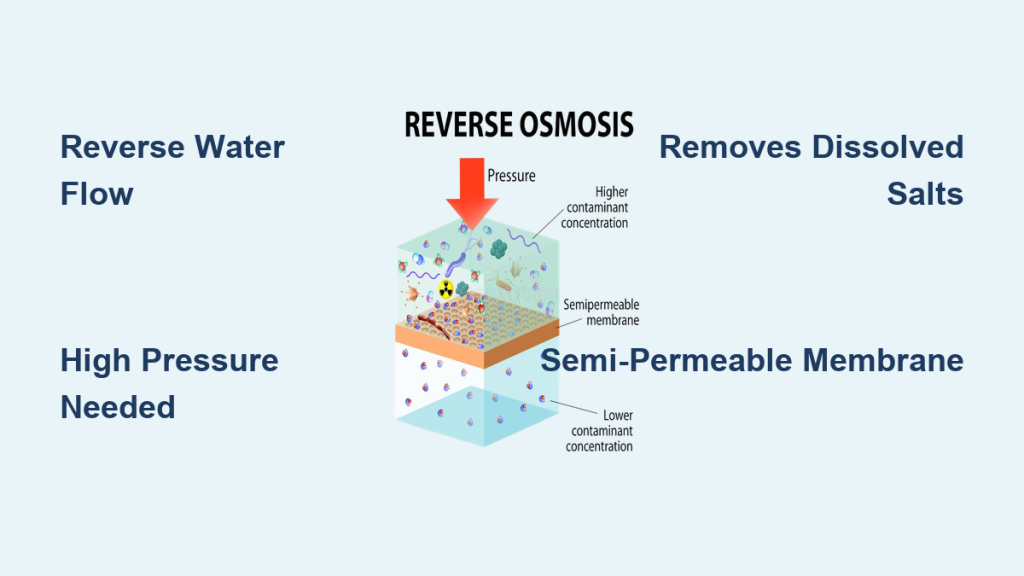
If you have ever wondered why the term “reverse osmosis” sounds so scientific, you are not alone. The name actually describes exactly what happens at the molecular level: water is forced to move in the opposite direction of how it would naturally flow. Understanding this distinction reveals why reverse osmosis is so effective at removing contaminants like lead, fluoride, and dissolved salts that other filters cannot touch. The word “reverse” is not marketing hype. It is physics.
This guide breaks down the science behind the name, explains how osmosis works in nature, and shows why calling it simply “osmosis” or “filtration” would be scientifically inaccurate. You will learn what really happens at the molecular level, how pressure overcomes natural forces, and why this technology powers everything from under-sink home systems to massive desalination plants.
How Osmosis Works Naturally
Before understanding reverse osmosis, you must first understand the natural process it reverses. Osmosis is the spontaneous movement of water through a semi-permeable membrane from an area of low solute concentration to an area of high solute concentration. This movement requires no external energy. It happens on its own.
Water Moves to Balance Concentration
When freshwater and saltwater are separated by a semi-permeable membrane, water naturally flows into the saltwater side. This happens because the water wants to equalize the concentration on both sides. The movement continues until equilibrium is reached or until pressure builds up enough to stop it, which is called osmotic pressure.
A Passive Process That Needs No Energy
One key feature of osmosis is that it is passive. Cells use it to regulate fluid balance, plants rely on it to draw water from soil, and kidneys use it to filter blood. No pumps or external power are required. The driving force is simply the difference in solute concentration across the membrane.
What Makes It “Reverse”
The “reverse” in reverse osmosis refers to flipping the natural direction of water flow. Instead of letting water move toward a contaminated solution, pressure forces it the other way.
Applying Pressure Against Nature
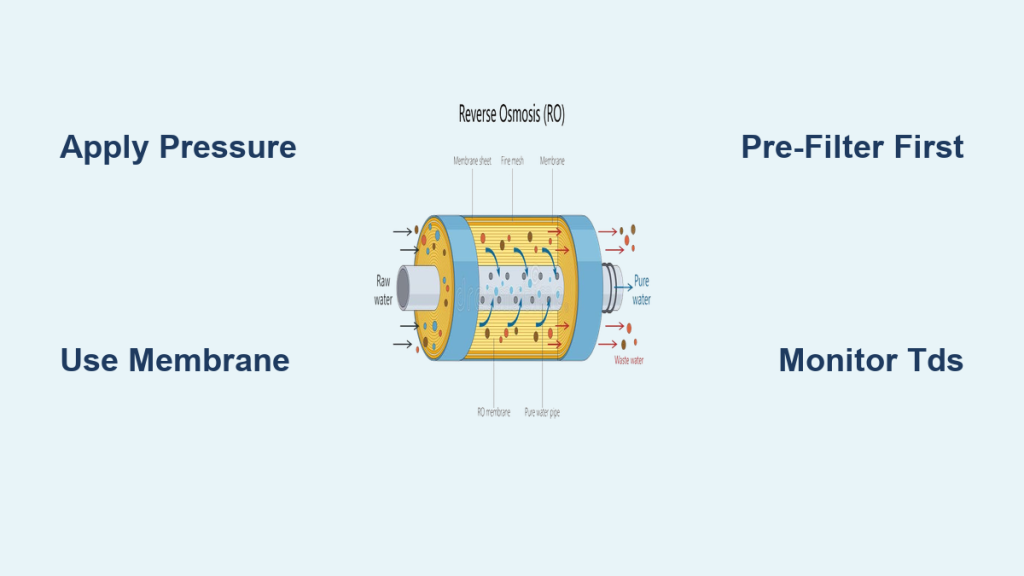
In reverse osmosis, external pressure is applied to the concentrated side of the membrane. This pressure must exceed the natural osmotic pressure to push water molecules through while leaving behind salts, heavy metals, and dissolved solids. For home systems, this is typically 40 to 80 psi. For seawater desalination, it can be up to 350 psi.
Instead of water moving toward higher concentration, it is driven away from it. That is exactly why it is called reverse osmosis.
Why Simple Filtration Is Not the Same
Standard filters trap particles based on size. They work like a sieve, catching anything larger than their pores. Reverse osmosis operates differently. It uses a semi-permeable membrane that allows only water molecules to pass under pressure, rejecting ions based on charge and hydration radius. It is not just physical straining. It involves thermodynamic and molecular processes.
Why the Name Matters Scientifically
The term reverse osmosis is not arbitrary. It is scientifically precise, and misunderstanding it leads to common misconceptions.
Osmosis Only Goes One Way Naturally
Some people argue that osmosis goes both ways, so “reverse” is unnecessary. However, by scientific definition, osmosis refers specifically to the spontaneous movement of water into a more concentrated solution. Any process that forces water the other way against that gradient is the reverse. It is like gravity. Objects fall naturally. If you throw a ball upward, you are reversing gravity. You would not call that “gravity” again.
It Is the Water That Moves, Not the Solutes
A common misunderstanding is that salts or contaminants are moving through the membrane in reverse osmosis. They are not. In natural osmosis, water moves toward the salt. In reverse osmosis, water is pushed away from the salt. The salt stays behind. Only the water passes through.
Visualizing the Process
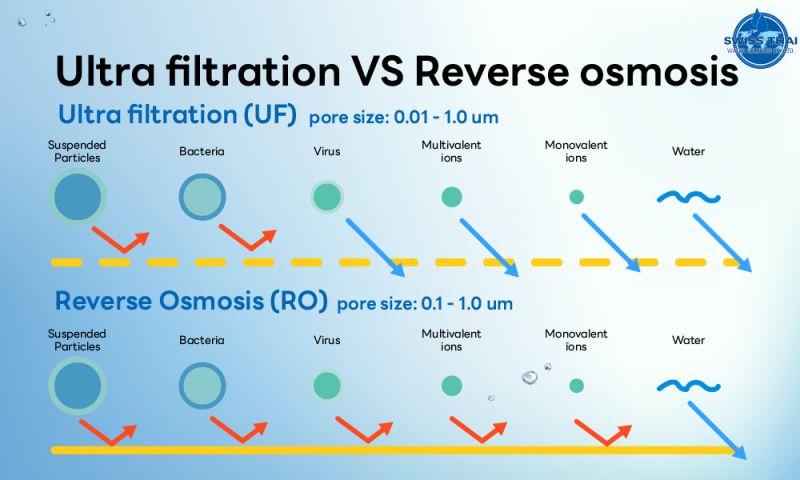
Three scenarios help illustrate how reverse osmosis differs from natural osmosis and standard filtration.
Physical Filtration With No Concentration Gradient
Muddy water and clean water sit on either side of a mesh screen. Nothing moves unless you apply pressure. Flow depends only on force, not chemistry.
Natural Osmosis With No External Pressure
Freshwater and saltwater are separated by a semi-permeable membrane. Water flows into the saltwater side even with no pump because of osmotic pull.
Reverse Osmosis With Pressure Overcoming Osmosis
Apply strong pressure to the saltwater side. When it exceeds osmotic pressure, water is forced back through the membrane, producing fresh water. This reversal is what makes the technology work.
What Reverse Osmosis Removes
Reverse osmosis is one of the most effective home water treatments available, removing contaminants that other systems simply cannot handle.
Contaminants Reduced Significantly
Reverse osmosis can remove more than 99% of heavy metals including lead and arsenic. It reduces fluoride by about 90% and removes up to 98% of total dissolved solids. It also eliminates microplastics and cysts with greater than 99% efficiency. RO is the only filtration method proven to reliably remove fluoride and nitrate.
What Gets Through Despite the Membrane
RO does not catch everything. Dissolved gases like carbon dioxide, hydrogen sulfide, and radon can pass through. Some volatile organic compounds may also make it through unless the system includes carbon filtration stages. That is why multi-stage systems are essential.
How RO Systems Work in Practice
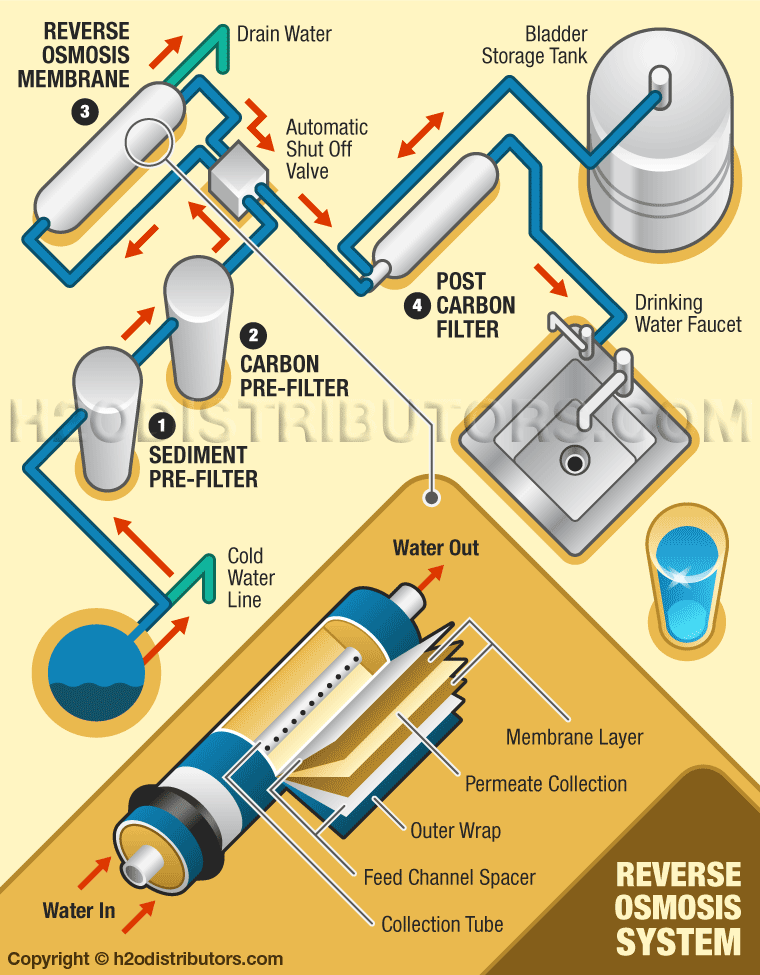
Modern residential RO systems use multiple stages to maximize effectiveness and address the limitations of the membrane alone.
Typical Five-Stage Design
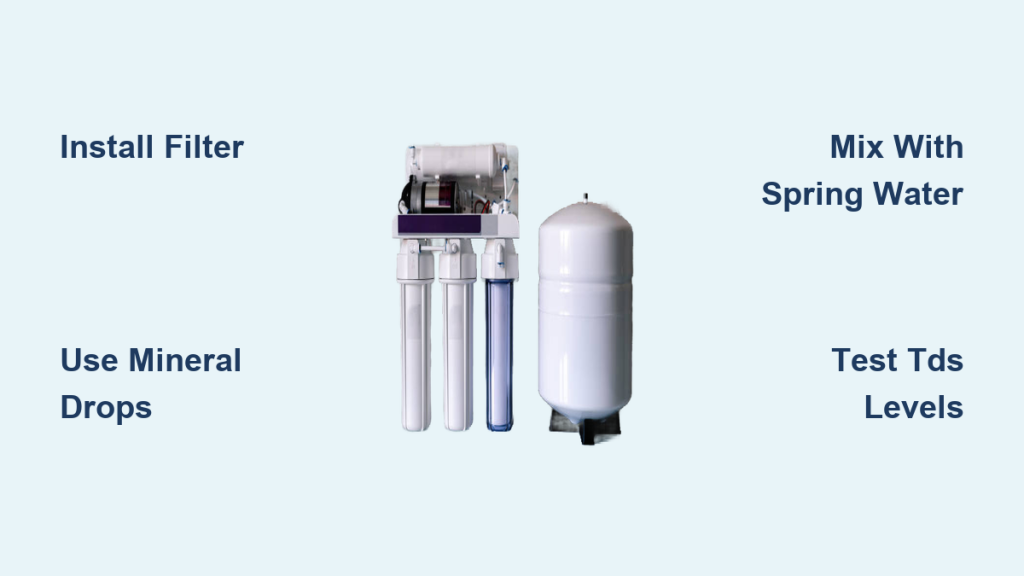
A sediment pre-filter removes sand, silt, and rust particles that could clog the membrane. A carbon pre-filter reduces chlorine and volatile organic compounds while protecting the membrane from chemical damage. The RO membrane itself is the core stage where reverse osmosis occurs, pressurized to reject dissolved solids. A post-carbon filter catches any remaining odors or VOCs. An optional remineralization stage adds back beneficial minerals like calcium and magnesium for better taste and pH balance.
Real-World Applications
Reverse osmosis serves critical roles across many scales and industries.
From Homes to Cities
Under-sink RO systems provide clean drinking water in residential kitchens. Restaurants use RO for better-tasting coffee and ice. In Dubai, reverse osmosis produces approximately 416 million gallons of drinking water daily, supplying nearly all of the city is potable water needs. This requires processing over 2.8 billion gallons of seawater per day.
Key Takeaways for Understanding the Name

The name reverse osmosis accurately describes the scientific process of forcing water through a membrane against its natural osmotic gradient. It is an active process requiring energy in the form of pressure to reverse spontaneous molecular movement. The term emphasizes the thermodynamic reversal of a fundamental biological principle, distinguishing RO from standard filtration technologies. Calling it simply “filtration” would misrepresent the mechanism and overlook the scientific basis. The name is precise because it literally reverses how water naturally moves.
Frequently Asked Questions About Why It Is Called Reverse Osmosis
Why is the word “reverse” in the name?
The word “reverse” refers to reversing the natural direction of osmosis. In nature, water moves from low concentration to high concentration through a membrane. Reverse osmosis applies pressure to force water in the opposite direction, from high concentration to low concentration.
Is reverse osmosis the same as filtration?
No. Standard filtration relies on physical sieving, trapping particles larger than the filter pores. Reverse osmosis uses a semi-permeable membrane and pressure to remove dissolved ions, not just particles. It operates on thermodynamic principles, not just mechanical ones.
Does reverse osmosis remove salt from water?
Yes. In desalination, salt water is pressurized and forced through the membrane. Pure water passes through while salts are retained and flushed away as wastewater. This is how seawater becomes drinkable.
Can osmosis happen in both directions naturally?
No. By scientific definition, osmosis specifically refers to the spontaneous movement of water toward higher solute concentration. The term “reverse” is necessary because the process forces water the opposite way using external pressure.
What pressure is needed for reverse osmosis?
Home systems typically require 40 to 80 psi of pressure. Seawater desalination needs much higher pressure, around 350 psi, to overcome the strong osmotic pressure from the salt.
Why not just call it osmosis?
Calling it osmosis would be scientifically incorrect because osmosis refers only to the passive, spontaneous movement of water. Reverse osmosis is an active, energy-driven process that opposes this natural flow. The term “reverse” accurately describes the difference.