You turn on your kitchen faucet and pour a glass of crystal-clear water. It tastes fresh, clean, and free of any odd smell or aftertaste. That water was purified using reverse osmosis, one of the most effective home water filtration technologies available. But how does a reverse osmosis system work? At its core, RO forces water through a microscopic membrane that blocks nearly all contaminants, delivering purified drinking water straight from your tap.
Unlike basic filters that catch dirt or carbon systems that absorb chlorine, reverse osmosis uses pressure-driven membrane separation to remove dissolved solids, heavy metals, chemicals, and even microplastics. It is the same technology used by bottled water companies and large-scale desalination plants. In this guide, you will learn exactly how each stage of an RO system contributes to cleaner water, from the first sediment filter to the final polishing carbon stage.
The Science Behind Reverse Osmosis
Understanding Natural Osmosis
Osmosis is a natural process where water moves through a semi-permeable membrane from a low-solute area to a high-solute area. Plant roots absorb water from soil this way. No energy is needed because the movement is driven purely by concentration differences. In a glass of saltwater, pure water would naturally flow into the salty side until both sides reach balance. This passive movement is driven by osmotic pressure, a force created by the imbalance of dissolved substances.
How Reverse Osmosis Defies Nature
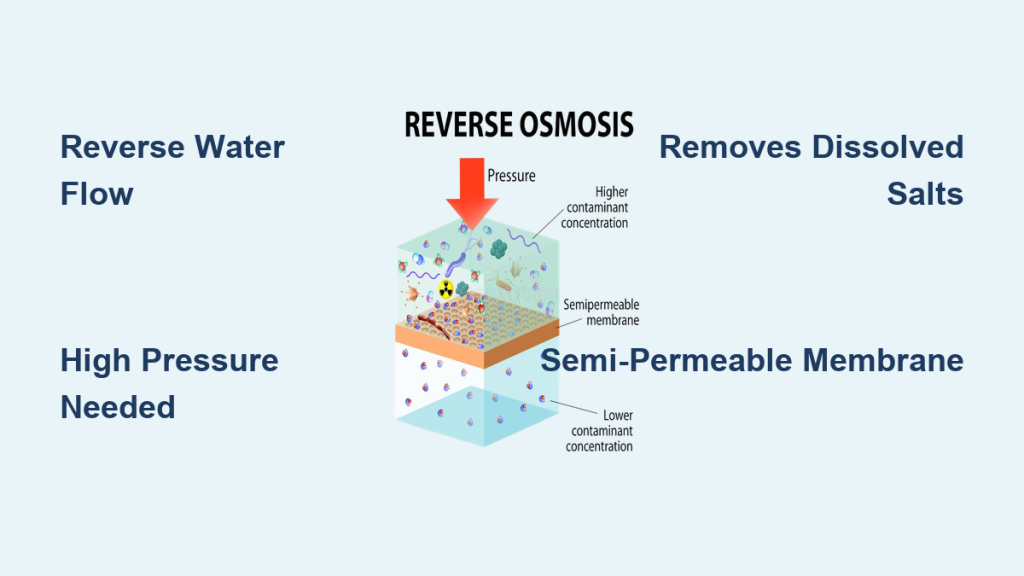
Reverse osmosis flips this process entirely. Instead of letting water move toward contamination, external pressure pushes contaminated water against its natural flow, forcing it through a membrane that allows only H₂O molecules to pass. This requires 40 to 80 psi of household water pressure, or more with a booster pump. The pressurized feed water hits the RO membrane, and while water molecules slip through, contaminants like sodium, lead, and nitrates are too large or repelled by charge, and get flushed away as waste.
The result is two distinct streams. Permeate is clean, drinkable water stored in a tank. Brine is the concentrated contaminants sent down the drain. This separation is not just filtration. It is molecular-level purification based on size, charge, and hydration effects.
Why Even Tiny Ions Get Blocked
Even tiny ions like sodium and chloride are stopped, not just because of their physical size, but due to two key factors. First, charge repulsion: most RO membranes have a negatively charged polyamide layer that repels anions like chloride. Second, hydration shells: ions attract a shell of water molecules around them, making them behave as if they are much larger than individual water molecules. While an ion might be small, its effective size in solution exceeds the 0.0001-micron pore rating of the membrane, ensuring rejection rates up to 99 percent for many dissolved solids.
The Multi-Stage Filtration Process Explained
Stage 1: Sediment Pre-Filter Protects the Membrane
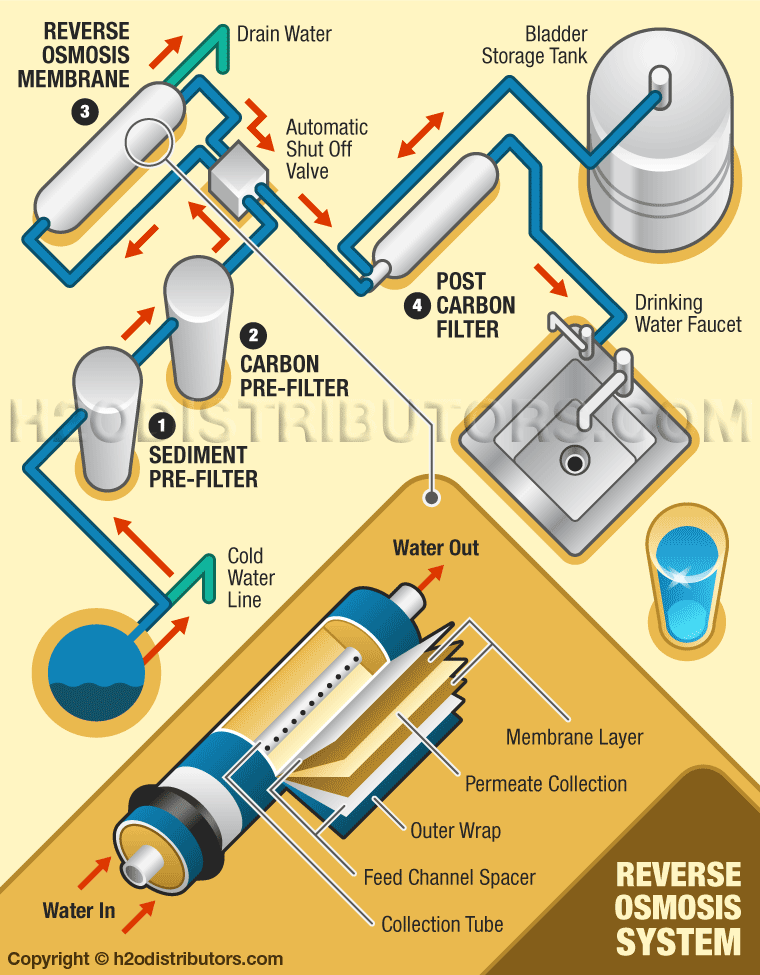
Before water reaches the delicate RO membrane, it passes through a 5-micron sediment filter. This first line of defense removes visible particles such as rust flakes, sand, silt, pipe scale, and turbidity. Water flows down the outer wall of the filter housing, then up through the pleated or spun polypropylene media. Without this step, abrasive particles could scratch or clog the membrane, reducing efficiency and lifespan.
Warning signs that this filter needs attention include visibly cloudy water or grit in faucets. Check this filter every 3 to 6 months, especially if your water is particularly dirty.
Stage 2: Carbon Block Removes Chlorine and Chemicals
Next, water flows into one or two activated carbon block filters. These remove chlorine and chloramines, pesticides, herbicides, volatile organic compounds, and bad tastes and odors. Carbon works via adsorption, where contaminants stick to the massive surface area inside the porous carbon structure.
The most critical job of this stage is protecting the RO membrane. Most residential RO membranes are made of thin-film composite material, which degrades when exposed to chlorine. Even low levels can cause irreversible oxidation, leading to reduced rejection rates and early failure. Using solid carbon blocks rather than granular ensures longer contact time and better protection.
Stage 3: RO Membrane Is the Heart of the System
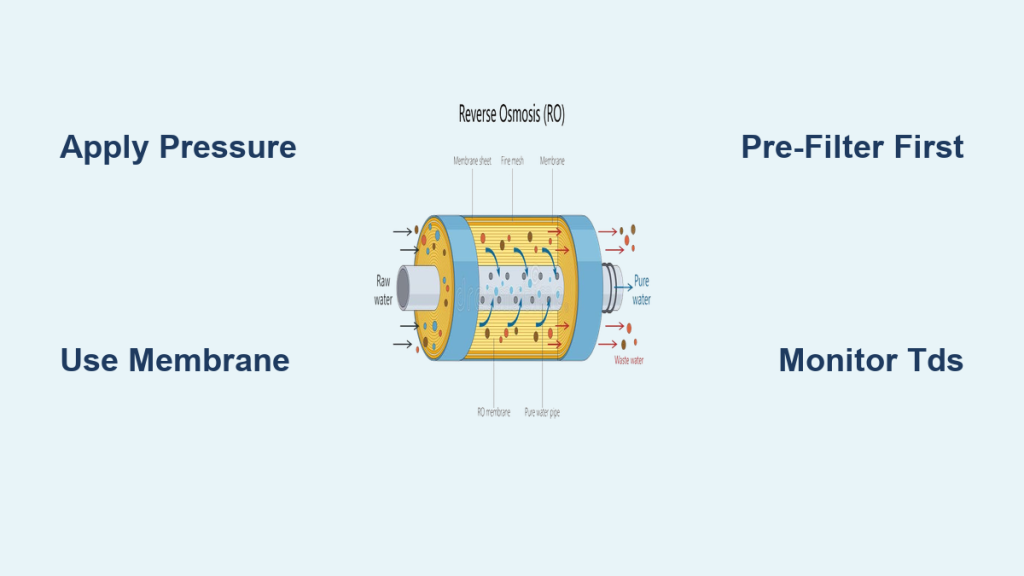
Now comes the core purification step: the semi-permeable RO membrane. Typically a spiral-wound thin-film composite membrane, it consists of three layers. The polyester support layer provides strength. The micro-porous polysulfone layer offers reinforcement. The polyamide barrier layer is the active filtration surface.
This membrane has pores around 0.0001 microns, so small that only water molecules can pass. Everything else gets rejected. It removes up to 99 percent of TDS, lead, mercury, cadmium, arsenic and chromium-6, nitrates and sulfates, PFAS forever chemicals, microplastics, and most bacteria and viruses via size exclusion.
The spiral-wound design wraps membrane sheets around a central permeate tube with spacers. The feed spacer creates turbulence to prevent scaling. The permeate spacer channels clean water to the core. Under pressure, purified water moves through the membrane into the core tube, while contaminants stay behind and exit via the brine line.
Stage 4: Brine Flush Keeps the Membrane Clean
As the RO membrane filters water, rejected contaminants build up on its surface. To prevent fouling, RO systems use a crossflow design, where a portion of the feed water flows across the membrane, carrying waste to the drain. A flow restrictor controls how much water becomes brine, typically 3 to 5 gallons wasted per 1 gallon purified.
This steady flush prevents mineral scaling, reduces biofilm formation, and extends membrane life. Without this self-cleaning action, the membrane would quickly clog and lose efficiency.
Stage 5: Polishing Post-Carbon Filter Ensures Great Taste
After storage, RO water passes through a final carbon filter before reaching your faucet. This post-filter removes any residual taste or odor picked up in the tank and prevents plastic or rubbery tastes from tank lining. Even though the water is already pure, this step guarantees the best possible taste every time you pour a glass.
Storage and Delivery System Components
Pressurized Storage Tank Provides Instant Water
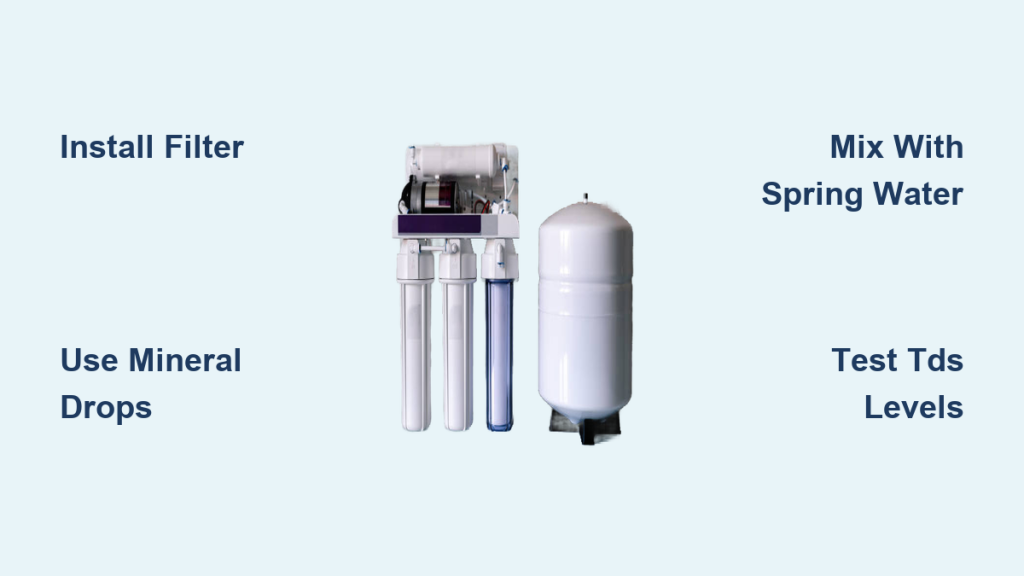
RO membranes produce water slowly, about 2 to 3 ounces per minute. That means filling a glass takes time unless there is a reserve. The pressurized storage tank solves this problem. It holds 2.5 to 4 gallons of purified water and uses a butyl rubber bladder pre-charged to 7 to 8 psi. As water enters, it compresses air, creating backpressure for instant flow. When you open the faucet, compressed air pushes water out fast with no waiting.
Pro tip: Check tank pressure annually. If pressure drops below 7 psi when empty, refill with a bike pump to restore performance.
Automatic Shut-Off Valve Prevents Waste
Without a shut-off mechanism, the RO system would keep running once the tank is full, wasting water and stressing components. The automatic shut-off valve closes when tank pressure reaches about two-thirds of incoming line pressure. It reopens when water is drawn and pressure drops. This simple device reduces unnecessary wastewater by up to 80 percent.
Dedicated Air-Gap Faucet Ensures Safety
RO systems require their own air-gap faucet, usually mounted beside the kitchen sink. Key features include dispensing only purified water and containing an air gap between the spout and drain line to prevent back-siphonage. If the sink floods, water cannot siphon back into the RO system, ensuring safety and code compliance.
Optional Upgrades for Better Performance
Permeate Pump Reduces Water Waste
Standard RO systems waste 3 to 5 gallons of water per gallon made. A permeate pump cuts this dramatically. Installed on the brine line, it uses energy from the waste stream to push purified water into the tank, reducing wastewater by 75 to 80 percent. Benefits include achieving near 1:1 water recovery ratio, no electricity required, quieter operation, and extended membrane life.
Booster Pump Helps With Low Pressure
If your home water pressure is below 40 psi, or your TDS exceeds 500 ppm, an electric booster pump ensures optimal performance. It maintains 60 plus psi at the membrane, increases daily output, improves contaminant rejection, and is essential for well water or high-altitude homes. Without adequate pressure, RO production slows and purity drops.
Remineralization Filter Improves Water Taste
One downside of RO is that it removes beneficial minerals like calcium and magnesium, leaving water slightly acidic. A remineralization filter adds these back, raises pH to neutral or slightly alkaline, enhances taste, and reduces corrosivity in plumbing. It contains calcite and magnesium oxide media. This is important for long-term consumption and protecting appliances like coffee makers.
UV Disinfection Provides Microbial Protection
While RO blocks most microbes due to size, it does not disinfect. Live pathogens like viruses or cysts may survive. For well water or microbiologically unsafe sources, add UV sterilization after the storage tank. UV light destroys 99.99 percent of bacteria, viruses, and cysts without chemicals. It is the final safety net for complete protection.
What Contaminants Reverse Osmosis Removes
Dissolved Solids and Heavy Metals
RO excels at removing inorganic contaminants. It reduces TDS by up to 99 percent, removes sodium which is critical for softener bypass, eliminates over 95 percent of lead, effectively removes arsenic especially in well water, reduces fluoride by 90 to 95 percent, significantly removes chromium-6, and blocks cadmium, mercury, and nickel via size and charge. This makes RO ideal for areas with hard water, industrial runoff, or aging pipes.
Organic Chemicals and PFAS
RO is one of the few household methods proven effective against PFAS and PFOS, the forever chemicals linked to health risks. It also removes benzene and toluene which are volatile organic compounds, pesticides and herbicides, pharmaceutical residues, and microplastics. Combined with carbon pre-filtration, RO provides broad-spectrum chemical protection.
Microbiological Contaminants
RO membranes block E. coli and Salmonella which are bacteria, Giardia and Cryptosporidium which are cysts, and most viruses due to size. However, it is not a sterilizer. Some viruses are small enough to potentially pass, especially if the membrane is damaged. Use UV post-treatment if your source water is not microbiologically safe.
Performance Metrics and Efficiency
Gallons Per Day Rating
RO systems are rated by maximum daily output under ideal conditions. A 35 to 50 GPD system is good for 1 to 2 people. A 75 GPD system is ideal for families. A 100 plus GPD system is for high-demand or commercial use. Actual output depends on water pressure, temperature where cold water slows production, feed water TDS, and membrane condition. A 50 GPD system produces about 3.5 gallons per day in real-world use, not constant flow.
Water Waste Ratio and Reuse Options
Standard systems produce 3 to 5 gallons of brine per gallon of RO water. This waste flushes prevents scaling, maintains membrane efficiency, and ensures consistent quality. You can reduce waste by using a permeate pump which reduces waste by up to 80 percent, using smart controllers that optimize flush cycles, or using recirculating systems for industrial applications.
Though not drinkable, brine can be repurposed for toilet flushing, outdoor cleaning, car washing, or irrigation for salt-tolerant plants. Using reject water offsets environmental impact and improves sustainability.
Types of RO Systems Compared

Under-Sink Point-of-Use Systems
Most common type is installed under the kitchen sink. Features include 3 to 5 stages, storage tank and dedicated faucet, treating drinking and cooking water only, easy DIY installation, and a cost of 150 to 500 dollars. This is best for homes with decent water pressure and moderate contamination.
Whole-House Point-of-Entry Systems
These treat all incoming water and are reserved for severe cases like brackish water, seawater intrusion, or TDS over 1,000 ppm. Requirements include large pre-filters, softener or iron filter, booster pump, 100 plus gallon tank, and UV post-treatment. Cost ranges from 1,000 to 5,000 dollars or more. This is life-changing in rural or coastal areas.
Countertop and Portable Units
No plumbing is needed. These connect to faucet via diverter or use a reservoir. Pros are being rent-friendly, portable, and easy to set up. Cons are lower GPD, smaller tank, and less durability. Price ranges from 100 to 300 dollars. This is ideal for temporary use or apartments.
Essential Maintenance Requirements
Filter Replacement Schedule
Keep your RO system running smoothly by replacing sediment and carbon pre-filters every 6 to 12 months. Replace the post-carbon filter every 6 to 12 months. Replace the RO membrane every 2 to 3 years. Replace the membrane if TDS in RO water exceeds 30 to 35 percent of feed water, if flow rate drops noticeably, or if water develops off-taste. Use a digital TDS meter to monitor performance.
Annual Checks You Should Do
Perform these checks yearly. Test tank air pressure which should be 7 to 8 psi when empty. Sanitize the system annually especially with well water. Inspect for leaks, corrosion, or kinks. Clean the faucet aerator. In winter, protect from freezing because burst pipes and damaged membranes are common in unheated basements.
Expected System Lifespan
With proper care, RO systems last 10 to 15 years. Some brands offer limited lifetime warranties on housings and tanks. Longevity depends on water quality, maintenance frequency, and component quality.
When to Choose Reverse Osmosis
RO Is Best For
Choose RO if you have high TDS or hard water, lead arsenic or PFAS contamination, need sodium reduction if using a water softener, use well water with unknown quality, need water for reef aquariums or lab use, or want bottled-water taste without plastic waste. You want maximum purification for drinking and cooking.
Consider Alternatives If
Consider alternatives if your tap water meets EPA standards and tastes fine, you are on a tight budget including upfront and maintenance costs, water pressure is too low for effective RO, you prefer mineral-rich water and dislike remnant acidity, or you are concerned about water waste and cannot reuse brine. In those cases, a good carbon filter or water softener may suffice.
Frequently Asked Questions About Reverse Osmosis
How long does it take to fill an RO storage tank?
A typical RO system produces 2 to 3 ounces per minute, so filling a 3-gallon tank takes 2 to 4 hours. This is why the storage tank is essential. You get instant water when you need it because the tank pre-fills during idle time.
Does reverse osmosis remove bacteria and viruses?
RO membranes block most bacteria and viruses due to their size, but RO is not a disinfection method. Some viruses may pass through if the membrane is damaged. For microbiologically unsafe water sources like private wells, adding UV post-treatment is strongly recommended.
How much water does an RO system waste?
Standard RO systems waste 3 to 5 gallons of water for every 1 gallon of purified water produced. This is due to the crossflow design that flushes contaminants away. Using a permeate pump can reduce this waste by up to 80 percent, achieving near 1:1 efficiency.
Does RO remove beneficial minerals from water?
Yes, RO removes dissolved minerals including beneficial ones like calcium and magnesium. This leaves water slightly acidic. You can add a remineralization filter to put essential minerals back and raise pH to neutral. Alternatively, mineral needs are best met through diet rather than water.
How often should I replace the RO membrane?
Replace the RO membrane every 2 to 3 years under normal conditions. Replace sooner if TDS in RO water exceeds 30 to 35 percent of feed water, if flow rate drops significantly, or if water tastes different. A digital TDS meter helps monitor membrane performance.
Can I install an RO system myself?
Yes, most under-sink RO systems are designed for DIY installation. Basic tools needed include a drill for the faucet hole, adjustable wrenches, and possibly a screwdriver. Follow the manufacturer’s instructions carefully. Professional installation is recommended for whole-house systems or if you are not comfortable with basic plumbing.
Key Takeaways for Understanding Reverse Osmosis
Reverse osmosis is one of the most powerful tools for home water purification. By combining sediment filtration, carbon adsorption, and membrane science, it delivers consistently high-quality water that removes up to 99 percent of contaminants including lead, PFAS, fluoride, and dissolved solids. The multi-stage process protects the membrane, ensures great taste, and provides water that rivals bottled water quality at a fraction of the cost.
Modern RO systems are more efficient, sustainable, and health-conscious than ever. With optional upgrades like remineralization, UV disinfection, and permeate pumps, you can customize performance to your specific water quality needs. Whether you are protecting your family’s health, maintaining a reef aquarium, or simply wanting better-tasting water, understanding how reverse osmosis works empowers you to make smarter water choices for your home.