Hard water leaves stubborn spots on dishes, clogs pipes with scale, and makes soap struggle to lather. You likely need a water softener, but buying the wrong size creates new problems like wasted salt or bacterial growth. The solution lies in calculating the correct water softener capacity for your specific home.
This guide explains how to measure your water hardness, adjust for iron contamination, and apply the right formula for your household size. You will learn to avoid common sizing errors that lead to frequent breakdowns or poor water quality. Follow these steps to select a unit that balances efficiency with performance.
How Grain Capacity Determines System Performance

Grain capacity measures the total amount of hardness minerals a unit can remove before it must recharge. One grain equals 1/7000th of a pound of dissolved calcium and magnesium. A 40,000-grain system does not last forever. It simply means the resin bed can hold 40,000 grains of hardness before saturation occurs.
The resin inside the tank traps these minerals as water flows through. Once the resin reaches its limit, the system must flush the minerals out and recharge with brine. This process is called regeneration. Your goal is to match this capacity to your daily usage so the system regenerates at an optimal frequency.
Why Regeneration Frequency Impacts Costs
Regeneration consumes both water and salt. An undersized unit reaches its limit too quickly and regenerates daily. This excessive cycling wastes resources and wears out the resin beads faster than normal.
Conversely, an oversized unit may go weeks without regenerating if your water use is low. Stagnant water sitting in the resin tank creates a breeding ground for bacteria. This can lead to foul “rotten egg” odors and degraded water quality.
Ideal Regeneration Window:
* Most experts recommend a cycle every 3 to 7 days.
* This frequency keeps the resin active and water fresh.
* It balances salt usage with consistent soft water delivery.
Measure Water Hardness and Iron Levels Accurately
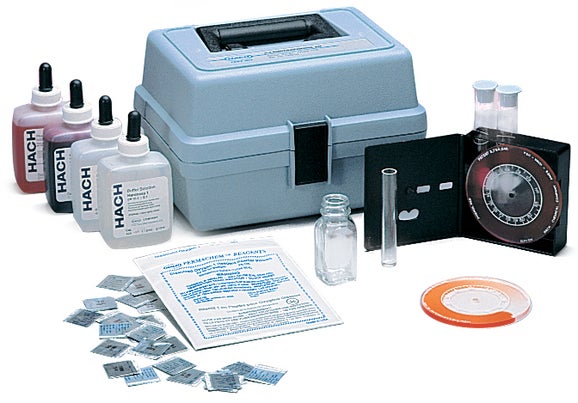
You cannot calculate water softener capacity without precise data. Your hardness level acts as the multiplier in every sizing equation. Using an estimate often leads to significant sizing errors.
Finding Your Hardness in Grains Per Gallon
Hardness is measured in grains per gallon (gpg). The method for finding this number depends on your water source.
City Water Users:
Check your annual Consumer Confidence Report (CCR). Your utility provider publishes this document online. It lists the average hardness level for your area.
Well Water Owners:
Municipal reports do not apply to private wells. You must use a certified test kit or send a sample to a laboratory. Home test strips provide rough estimates, but lab results offer the precision needed for proper sizing.
Hardness Classification Scale:
* 0–3 gpg: Soft
* 4–7 gpg: Moderately hard
* 8–10 gpg: Hard
* 11+ gpg: Very hard
If your test shows 15 gpg, every single gallon of water carries 15 grains of hardness. This adds up rapidly across a typical day of household usage.
Adjusting Capacity for Iron Contamination
Iron is a silent killer for water softeners. Even small amounts can coat the resin beads and reduce their ability to remove hardness. You must adjust your hardness number upward if iron is present.
Iron Adjustment Rule:
Add 3 to 5 grains of artificial hardness for every 1 part per million (ppm) of iron. Using 5 gpg per 1 ppm is the safer, more conservative approach.
Calculation Example:
* Measured Hardness: 10 gpg
* Iron Level: 2 ppm
* Adjustment: 2 × 5 = 10 gpg
* Adjusted Hardness: 10 + 10 = 20 gpg
Use the adjusted figure of 20 gpg for all sizing calculations. This ensures the resin bed is not overwhelmed by iron fouling.
Pro Tip: If your iron levels exceed 3 ppm, a standard softener may struggle. Consider installing a dedicated iron filter before the softener to protect the resin.
Calculate Daily Water Usage for Your Household
The second variable in the water softener capacity equation is volume. You need to know how many gallons your household uses daily.
Using the Standard Per-Person Estimate
The industry standard, cited by the EPA, estimates average daily water use at 75 gallons per person. This covers showers, laundry, dishwashing, and cooking.
Daily Volume Formula:
Number of People × 75 gallons = Daily Usage
Example Calculation:
A family of four would calculate: 4 × 75 = 300 gallons per day.
Adjusting for High-Usage Lifestyles
The standard 75-gallon estimate assumes average habits. You must increase this number if your home has high-demand features or behaviors.
Factors Requiring Higher Estimates:
* Frequent laundry loads with large-capacity machines
* Multiple showers running simultaneously
* Large soaking tubs or hot tubs
* Regular visits from guests
* Extensive indoor plumbing fixtures
If your household fits these descriptions, increase the per-person estimate to 80 or 100 gallons. This prevents the softener from running out of capacity during peak usage times.
Apply the Correct Sizing Formula for Your Needs

Once you have your adjusted hardness and daily volume, you can calculate the required grain capacity. Different formulas apply depending on how often you want the system to regenerate.
The Weekly Demand Model (7-Day Buffer)
This method calculates the grains needed to last a full week. It is the most common approach for ensuring the system handles weekly peaks like laundry days.
Formula:
(People × 75) × Adjusted Hardness × 7 Days
Example:
* 3 people, 12 gpg hardness, no iron
* (3 × 75) × 12 × 7
* 225 × 12 × 7 = 18,900 grains per week
Round this number up to the next standard unit size, which would be a 24,000-grain system.
The 3-Day Buffer Model
This approach assumes regeneration every three days. It is ideal for large families or homes with very high daily demand where preventing hard water breakthrough is critical.
Formula:
(People × 75) × Adjusted Hardness × 3 Days
Example:
* 4 people, 15 gpg hardness
* (4 × 75) × 15 × 3
* 300 × 15 × 3 = 13,500 grains
Even though the number is lower, you still round up to the nearest standard size, typically 24,000 grains.
Why the Daily Load Model Is Insufficient
Some guides only calculate the daily grain removal need. While this shows the strain on the system, it does not account for buffer time.
Daily Load Formula:
(People × 75) × Adjusted Hardness
Using the daily number alone often results in a unit that regenerates every single day. This is inefficient and costly. Always multiply your daily load by 3 or 7 to determine the true water softener capacity you need.
Select the Right Standard Unit Size
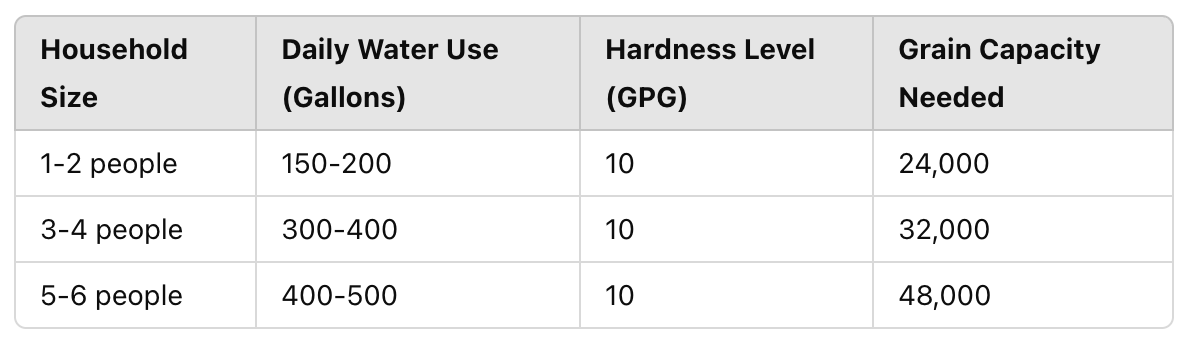
Water softeners are not sold in custom grain counts. You must choose from standard market sizes. Understanding these increments helps you make the final purchase decision.
Available Grain Capacity Tiers
Manufacturers typically produce units in the following capacities:
* 24,000 grains
* 32,000 grains
* 40,000 grains
* 48,000 grains
Selection Rule: Always round up to the next available size. If your calculation says you need 21,000 grains, buy the 24,000-grain model. Never round down.
Quick Reference Sizing Guide
| Household Size | Hardness (gpg) | Iron Present? | Adjusted Hardness | Daily Use (Gal) | 7-Day Need | Recommended Unit |
|---|---|---|---|---|---|---|
| 1–2 People | 8 | No | 8 | 150 | 8,400 | 24,000 grains |
| 3–4 People | 12 | No | 12 | 300 | 25,200 | 32,000 grains |
| 4 People | 10 | Yes (1 ppm) | 15 | 300 | 31,500 | 32,000–40,000 grains |
| 5+ People | 15 | No | 15 | 450 | 47,250 | 48,000+ grains |
Note that even small households often require the smallest standard unit (24,000 grains) because custom smaller sizes are rarely available.
Avoid Common Water Softener Sizing Mistakes
Errors in sizing lead to poor performance and wasted money. Being aware of these pitfalls ensures your investment lasts longer.
Ignoring Iron Levels Completely
Mistake: Using the raw hardness number without adding the iron penalty.
Consequence: The resin fouls within months, causing the softener to stop working effectively.
Fix: Test for iron and add 5 gpg per 1 ppm to your hardness total before sizing.
Relying on Bedroom Count
Mistake: Assuming a 3-bedroom house needs a specific size softener.
Consequence: This ignores actual occupancy and water habits, leading to over or undersizing.
Fix: Base your calculation on the number of people and their actual water usage patterns.
Buying Excessive Capacity “Just in Case”
Mistake: Installing a 48,000-grain unit for a couple with low water usage.
Consequence: The unit regenerates once a month. Water stagnates, leading to bacterial growth and odors.
Fix: Stick to the calculated need with only a small buffer. Do not double the required capacity.
Forgetting Peak Usage Days
Mistake: Sizing only for average daily use without a buffer.
Consequence: Hard water breaks through on laundry-heavy weekends.
Fix: Use the 7-day buffer model to absorb spikes in demand.
Verify Certification and Flow Rate Compatibility
Grain capacity is not the only spec that matters. You must also ensure the unit meets safety standards and can handle your home’s flow rate.
Check for NSF/ANSI 44 Certification
Look for the NSF/ANSI 44 label on any unit you consider. This certification verifies that the manufacturer’s capacity claims are accurate. It also confirms the structural durability and safety of materials used in drinking water systems. Non-certified units may overstate their grain capacity or use substandard resin.
Ensure Adequate Flow Rate
A unit might have the right grain capacity but fail to deliver enough water pressure during peak times. Flow rate is measured in gallons per minute (GPM).
Flow Rate Guidelines:
* Standard units typically deliver 15 to 20 GPM.
* Homes with multiple bathrooms or high-flow fixtures need at least 18 GPM.
If the flow rate is too low, you will experience pressure drops when multiple showers or appliances run simultaneously.
Maintain Your System to Preserve Capacity
Proper maintenance extends the life of your softener and ensures it operates at its rated water softener capacity.
Monitor Salt Levels Regularly
Check the brine tank every 4 to 6 weeks. Low salt levels lead to incomplete regeneration and hard water breakthrough. Refill the tank when the salt level drops below half full.
Clean the Brine Tank Annually
Salt mush and sediment can accumulate at the bottom of the tank. Drain and scrub the tank once a year to maintain optimal brine concentration and system efficiency.
Test Water Every Six Months
Water quality can change over time, especially for well owners. Re-test your water annually or if you notice scale returning to your fixtures. This ensures your sizing assumptions remain valid.
Replace Resin When Necessary
Resin beads degrade over time, typically lasting 10 to 15 years. If your softener runs through cycles but the water remains hard, the resin may be exhausted and require replacement.
Frequently Asked Questions About Water Softener Capacity
How often should a correctly sized water softener regenerate?
A properly sized unit should regenerate every 3 to 7 days. This frequency prevents water stagnation while ensuring the resin does not become oversaturated with hardness minerals.
What happens if I buy a water softener with too much capacity?
An oversized unit may go weeks without regenerating if water usage is low. This causes water to sit stagnant in the tank, promoting bacterial growth and foul odors like rotten eggs.
Can I use a water softener if my water has high iron levels?
Yes, but you must adjust your hardness calculation by adding 3 to 5 grains for every 1 ppm of iron. If iron exceeds 3 ppm, you may need a pre-filter to protect the resin from fouling.
Is it better to size using the 3-day or 7-day formula?
The 7-day formula is best for most households as it handles weekly peaks efficiently. Use the 3-day formula only if you have very high daily demand and want to prevent any chance of hard water breakthrough.
Do I need a larger softener for a well water system?
Not necessarily larger, but you must account for iron and sediment. Well water often requires an adjusted hardness calculation and potentially more frequent maintenance to protect the resin bed.
Key Takeaways for Optimizing Water Softener Capacity
Selecting the right water softener capacity requires precise data on your water hardness, iron levels, and daily household usage. By calculating your weekly grain demand and rounding up to the nearest standard unit, you ensure efficient operation without the risks of stagnation or frequent breakdowns. Remember to adjust for iron contamination and verify NSF certification to protect your investment.
Take action today by testing your water and running the numbers. A correctly sized system will save you money on salt, extend the life of your plumbing, and provide consistent soft water for years to come.