Choosing the wrong water softener size leads to wasted salt, frequent breakdowns, and hard water that ruins your appliances. Many homeowners guess at capacity or buy the biggest unit available, not realizing that oversizing causes channeling while undersizing triggers constant regeneration cycles. The solution lies in calculating your specific grain capacity needs based on actual water hardness and daily household usage rather than relying on rough estimates.
This guide walks you through the exact math to determine your ideal system size without confusion. You will learn how to convert hardness metrics, adjust for iron contamination, calculate daily grain demand, and apply the 65% efficiency rule for optimal performance. Follow these steps to select a unit that protects your plumbing and saves money on utilities for over a decade.
Determine Your Compensated Water Hardness

Accurate sizing starts with knowing exactly how hard your water is and whether it contains iron. Hardness is measured in grains per gallon (GPG), which dictates how much work your softener must perform daily.
Convert PPM to GPG Accurately
City water users can find hardness data in their annual Consumer Confidence Report, while well owners need a certified lab test. Reports often list hardness in parts per million (PPM) or milligrams per liter (mg/L).
- Divide your PPM number by 17.1 to get GPG.
- Example: 171 PPM divided by 17.1 equals 10 GPG.
- Water above 10.5 GPG is considered very hard.
Adjust Hardness for Iron Content
Iron fouls resin beads and reduces softening efficiency, requiring a capacity adjustment. For every 1 ppm of iron in your water, you must add extra grains to your hardness number.
- Add 3 GPG per ppm of iron for municipal water.
- Add 5 GPG per ppm of iron for well water or visible staining.
- Example: 10 GPG hardness plus 1 ppm iron equals 15 GPG compensated hardness.
Warning: Salt-free conditioners cannot remove iron or hardness minerals. You need a true ion-exchange softener if iron is present.
Calculate Your Daily Water Usage
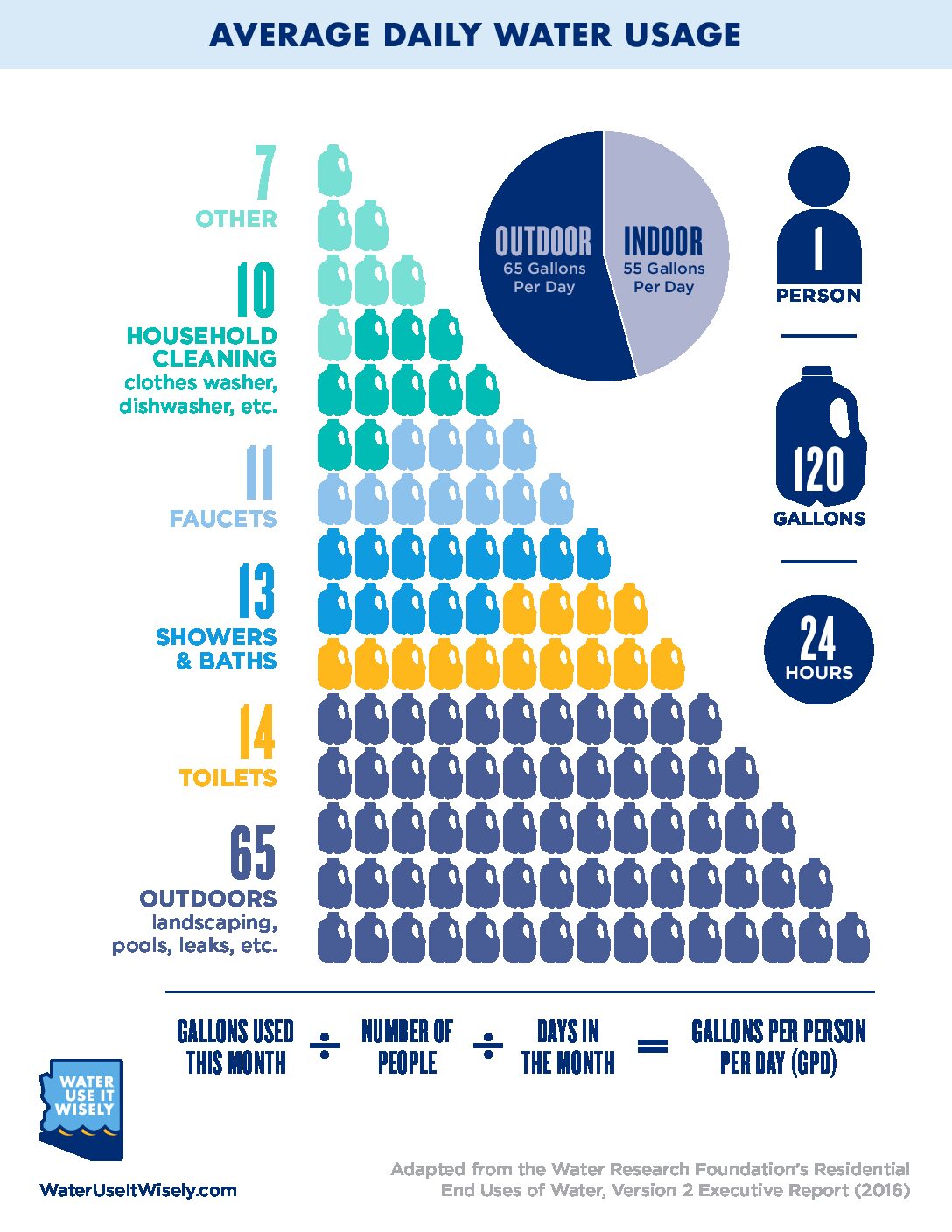
Once you have your compensated hardness number, estimate how many gallons your household consumes daily. This volume determines the total load your softener handles every 24 hours.
Use the Standard Per-Person Estimate
The industry standard for residential planning is 75 gallons per person per day. This covers drinking, bathing, laundry, and cleaning needs for an average home.
- Multiply 75 gallons by the number of people in your home.
- A family of three uses approximately 225 gallons daily.
- A family of five uses approximately 375 gallons daily.
Tip: Check your water bill for exact usage. Divide total monthly gallons by the number of days in the billing cycle for precision.
Account for High-Use Scenarios
Some households exceed the average due to specific habits or amenities. If your home has large soaking tubs, frequent laundry loads, or irrigation systems, increase your estimate.
- Use 80 gallons per person for high-use homes.
- Include guests or extended family stays in your count.
- Consider peak summer usage if you have a pool or garden.
Compute Daily Grain Demand

Multiply your daily water volume by your compensated hardness level to find your daily grain demand. This figure represents the total amount of hardness minerals your system must remove each day.
Apply the Grain Demand Formula
The formula is simple: Daily Gallons multiplied by Compensated GPG equals Daily Grain Demand. This number is the foundation for selecting your equipment size.
- Example 1: 225 gallons times 10 GPG equals 2,250 grains per day.
- Example 2: 375 gallons times 15 GPG equals 5,625 grains per day.
- Record this number carefully for the next calculation step.
Verify Your Math
Double-check your compensated hardness and gallon estimates before proceeding. A small error here can lead to choosing a unit that is too small or unnecessarily large.
- Ensure you used the adjusted GPG if iron is present.
- Confirm your household size estimate includes all residents.
- Round up slightly if your usage varies significantly day to day.
Establish Weekly Capacity Requirements

Most water softeners are programmed to regenerate once every seven days to maintain resin health and prevent bacterial growth. You must calculate the total grains your system needs to handle between these cycles.
Multiply Daily Demand by Seven
Take your daily grain demand and multiply it by seven to get your weekly requirement. This ensures your softener can last a full week without running out of capacity.
- Example 1: 2,250 grains times 7 equals 15,750 grains per week.
- Example 2: 5,625 grains times 7 equals 39,375 grains per week.
- This figure is your baseline minimum capacity need.
Understand Regeneration Frequency
Regenerating weekly is ideal for preventing resin stagnation and maintaining sanitary conditions inside the tank. Less frequent cycles can allow bacteria to grow, while more frequent cycles waste water and salt.
- Aim for a regeneration cycle every 5 to 7 days.
- Avoid systems that regenerate daily unless absolutely necessary.
- Adjust your target capacity if you prefer a specific schedule.
Apply the Efficiency Reserve Rule

Running a water softener at 100% of its rated capacity is inefficient and risky. You should size your unit so it only uses about 65% to 75% of its total capacity to ensure a safety margin.
Use the 65% Efficiency Factor
Divide your weekly grain requirement by 0.65 to find the minimum rated capacity you need. This builds in a 25% to 35% reserve for unexpected usage spikes.
- Formula: Weekly Grains divided by 0.65 equals Required Capacity.
- Example 1: 15,750 divided by 0.65 equals 24,230 grains.
- Example 2: 39,375 divided by 0.65 equals 60,577 grains.
Round Up to Standard Sizes
Manufacturers sell units in standard capacities like 32,000, 48,000, or 64,000 grains. Always round up to the next available size to meet your calculated target.
- A target of 24,230 grains requires a 32,000-grain unit.
- A target of 60,577 grains requires a 64,000-grain unit.
- Never round down, or you risk hard water breakthrough.
Match Capacity to Household Needs
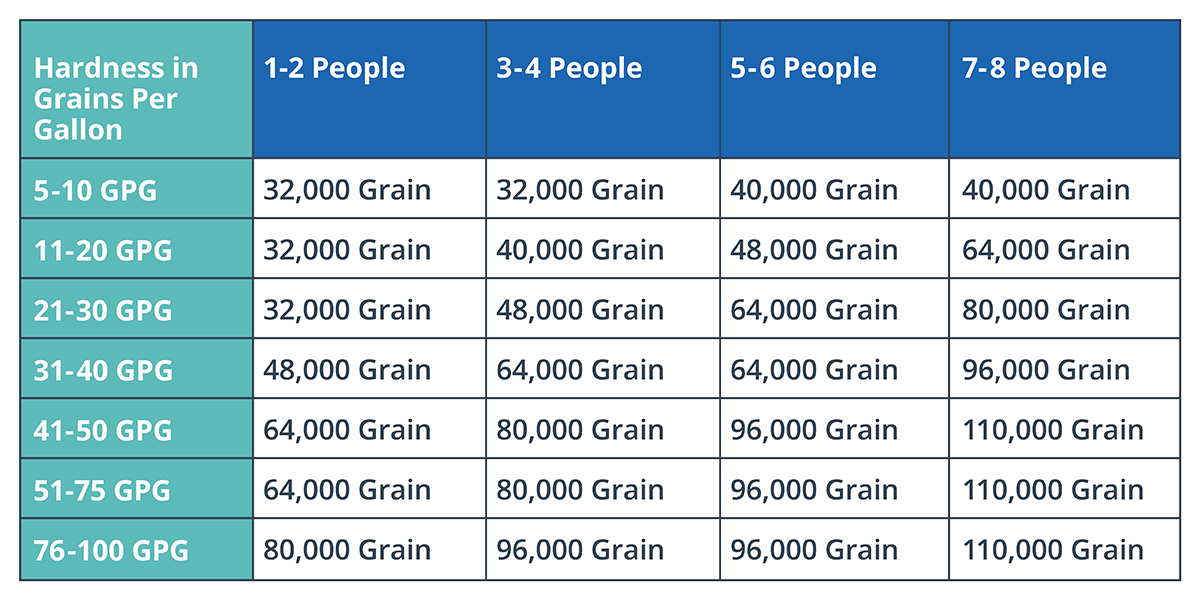
Use this reference table to quickly identify the standard unit size that fits your specific combination of household size and water hardness.
Residential Sizing Chart
| Hardness (GPG) | 1–2 People | 3–4 People | 5–6 People | 7+ People |
|---|---|---|---|---|
| 5 – 10 | 32,000 Grain | 32,000 Grain | 40,000 Grain | 48,000 Grain |
| 11 – 20 | 32,000 Grain | 40,000 Grain | 48,000 Grain | 64,000 Grain |
| 21 – 30 | 32,000 Grain | 48,000 Grain | 64,000 Grain | 80,000 Grain |
| 31 – 40 | 48,000 Grain | 64,000 Grain | 64,000 Grain | 96,000 Grain |
| 41+ | 64,000 Grain | 80,000 Grain | 96,000 Grain | 110,000+ Grain |
Note: If your hardness exceeds 15 GPG, always choose the larger option in your category to handle the extra mineral load effectively.
Verify Flow Rate Capabilities
Grain capacity handles the volume of hardness, but flow rate ensures you have enough water pressure when multiple fixtures are running simultaneously.
Assess Peak Water Demand
List the fixtures likely to run at the same time, such as two showers and a washing machine. Add their flow rates to find your peak demand in gallons per minute (GPM).
- Standard shower heads use about 2.5 GPM.
- Washing machines typically use 3.0 GPM.
- Dishwashers and faucets add 1.5 to 2.2 GPM each.
Match Unit Flow Ratings
Check the manufacturer specifications for the maximum flow rate of the softener you are considering. The unit rating must exceed your calculated peak demand.
- 32,000-grain units typically handle 15 to 18 GPM.
- 64,000-grain units often support 20 to 25+ GPM.
- Undersized flow rates cause pressure drops during peak use.
Avoid Undersizing Mistakes
Selecting a water softener that is too small creates immediate operational problems and increases long-term costs for your home.
Frequent Regeneration Cycles
An undersized unit exhausts its capacity quickly, forcing it to regenerate every two or three days. This excessive cycling wastes significant amounts of salt and water.
- Utility bills increase due to extra water usage.
- Salt consumption rises sharply.
- Mechanical parts wear out faster than normal.
Hard Water Breakthrough
When demand exceeds capacity, the resin bed becomes saturated before the next regeneration cycle. This allows hard water to flow into your home, causing scale buildup and soap scum.
- Appliances suffer from scale accumulation.
- Skin and hair feel dry and irritated.
- Cleaning efforts become less effective.
Prevent Oversizing Issues
Installing a unit that is too large for your needs is just as problematic as choosing one that is too small, primarily due to a phenomenon called channeling.
Understand Channeling Risks
Channeling occurs when water volume is too low to fill a large resin tank, causing water to carve a narrow path through the center. Most of the resin remains unused while hard water passes through the channel.
- Soft water is only available at very low flow rates.
- Showers and baths may feel hard despite a large unit.
- Resin life is wasted due to lack of full utilization.
Stagnation and Waste
Large tanks with low water usage allow water to sit stagnant for long periods, increasing the risk of bacterial growth. Additionally, large units use a fixed amount of salt and water for regeneration regardless of how much capacity was used.
- Bacterial growth risks increase in well systems.
- Salt efficiency drops significantly.
- Upfront costs are higher without functional benefit.
Handle Special Water Conditions
Certain water qualities require specific adjustments to your sizing strategy to ensure effective treatment and system longevity.
Manage Very Hard Water
Water with hardness above 15 GPG places extreme stress on standard residential units. You may need to move up a size category or consider a dual-tank system.
- Choose units with larger resin volumes (1.5 cu. ft. or more).
- Consider demand-initiated regeneration models.
- Increase salt dosage settings for complete resin recharge.
Treat Well Water with Iron
Well water often contains iron that requires special attention during the sizing process. Iron fouls resin, so you must compensate heavily and potentially add pre-filtration.
- Add 5 GPG for every 1 ppm of iron.
- Install sediment pre-filters for particles.
- Use iron-specific resin if iron levels exceed 0.3 ppm.
Select the Right Model Features
Now that you have your target capacity and flow rate, choose a model with features that match your specific household requirements and water quality.
Compare Key Specifications
Look beyond grain capacity to ensure the unit has the right features for your situation. Metered valves and high-purity salt compatibility are crucial for efficiency.
- Grain Capacity: Must meet or exceed your calculated target.
- Flow Rate: Must handle your peak simultaneous usage.
- Valve Type: Metered (DIR) valves adapt to actual usage.
- Warranty: Look for 10+ year coverage on the tank and valve.
Prioritize Demand-Initiated Regeneration
Demand-initiated regeneration (DIR) systems measure actual water use and regenerate only when needed. This technology optimizes salt and water usage compared to timer-based models.
- DIR systems save salt and water automatically.
- They adapt to changes in household size or habits.
- The base grain capacity calculation remains the same.
Maintain Optimal Performance
Proper maintenance ensures your correctly sized water softener continues to perform efficiently for its entire lifespan of 10 to 15 years.
Monitor Regeneration Schedules
Check your system settings to ensure regeneration occurs every 5 to 7 days. Adjust the schedule if your water usage patterns change significantly.
- Regenerating less than every 5 days suggests undersizing.
- Regenerating more than every 10 days risks stagnation.
- Adjust settings seasonally if usage varies.
Perform Regular Cleaning and Testing
Use high-purity salt pellets to reduce sludge buildup in the brine tank. Test your water hardness annually to ensure the system is still meeting your needs.
- Clean the brine tank once a year.
- Disinfect the resin bed every 1 to 2 years.
- Re-test water if you notice changes in taste or feel.
Frequently Asked Questions About Water Softener Sizing
How do I convert PPM to GPG for sizing?
Divide your PPM number by 17.1 to get the equivalent GPG value. For example, 200 PPM divided by 17.1 equals approximately 11.7 GPG. This conversion is essential because softener capacities are rated in grains.
What happens if I choose a water softener that is too big?
An oversized unit suffers from channeling, where water bypasses most of the resin bed. This results in poor softening performance, stagnant water that promotes bacterial growth, and wasted salt during regeneration cycles.
How often should a properly sized softener regenerate?
A correctly sized system should regenerate every 5 to 7 days. This frequency prevents resin stagnation and bacterial growth while ensuring you do not run out of soft water during peak usage times.
Do I need to adjust size for well water with iron?
Yes, you must add 3 to 5 grains of hardness for every 1 ppm of iron in your water. Well water also often requires more frequent regeneration or specialized resin to prevent iron fouling.
Can I use a salt-free conditioner for hard water?
Salt-free conditioners do not remove hardness minerals or iron. They only alter the structure of minerals to prevent scaling. They are not suitable for very hard water or situations where actual mineral removal is required.
Key Takeaways for Choosing Water Softener Size
Selecting the right water softener size requires calculating your compensated hardness, daily water usage, and weekly grain demand. Always apply the 65% efficiency rule to build in a necessary reserve capacity and round up to the nearest standard unit size. Ignoring flow rate requirements or iron content can lead to poor performance even with the correct grain capacity.
Start by testing your water today to get accurate hardness and iron levels. Use the formulas provided to calculate your specific needs before purchasing a unit. A properly sized system will protect your appliances, improve water quality, and save you money on utilities for years to come.